
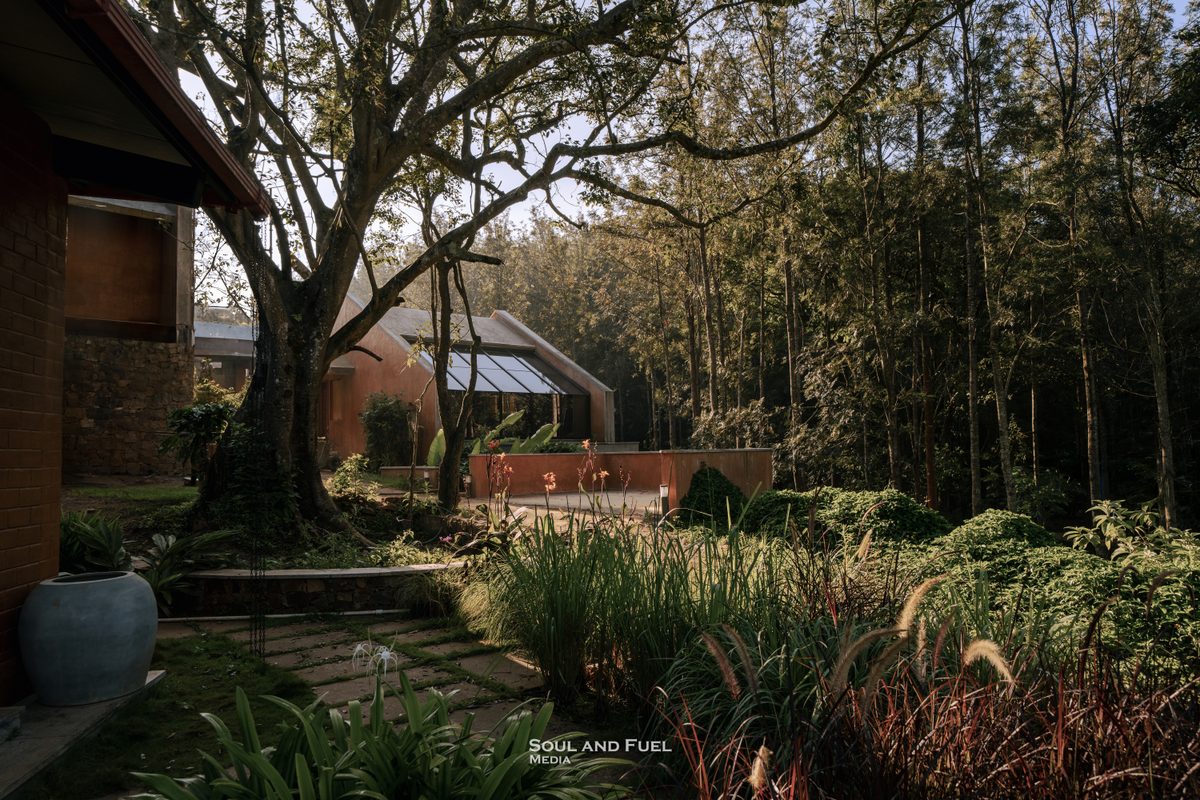
A house shoot rarely gets more than a day. Clients are paying for the property to sit empty, stylists are on the clock, and the light is only going to be right in each room for a narrow window. What looks like an unhurried, atmospheric photograph on the website is usually the result of a schedule planned almost to the minute.
The shot list is really a light list
Before I arrive, I build the day around the sun, not around the rooms. I'll walk the floor plan (or a video call with the site) and map every room to its window orientation, then sequence the shoot so I'm in each space near its best light, not in the order that's easiest to walk through. On a hillside home like this one in Chikmagalur, that meant starting with the east-facing breakfast room at sunrise, drifting through the interior corridors mid-morning when light matters less, and holding the west-facing living room and its valley view for the last two hours of daylight.
It sounds simple written down. In practice it means moving lighting kit, camera bodies and a laptop between rooms four or five times, and trusting the plan even when a stylist wants ten more minutes to fix a cushion in a room whose light is about to turn flat.
Styling has to happen in parallel, not in sequence
The biggest schedule killer on any shoot is waiting — for a room to be styled, for a table to be set, for flowers to arrive. The fix is to run styling and shooting as two overlapping tracks rather than one after another: while I'm shooting Room A, the stylist is already finishing Room B, so by the time I move, there's nothing left to wait for. It requires a stylist who can work fast and independently, and clear communication about which room is next so nobody is caught off guard.
What gets cut when the day runs long
Even with a tight plan, something always eats time — a delivery van blocking the one clean exterior angle, a room that needs restyling twice, weather. When that happens, the calls I make in order are: protect the golden-hour exterior shot first, protect the rooms whose good light is genuinely time-limited second, and treat detail shots (close-ups of materials, fixtures, joinery) as the flexible layer that can be finished after the light-critical shots are done, even into blue hour or the next morning if needed.
Knowing which shots are truly light-dependent and which aren't is the difference between a shoot that survives a delay and one that doesn't. A hero shot of a sunlit staircase can't be rescheduled to 6pm. A tight photograph of cabinet hardware can be taken any time the room is clean.
The takeaway for anyone commissioning a shoot
If you're booking interior or architecture photography and the property is only available for one day, the most useful thing you can do is share the floor plan and orientation in advance, and trust the photographer's sequencing over your own instinct for "logical" room order. A shoot that looks effortless in the final gallery is usually the product of a plan that treated daylight as the one resource nobody could negotiate with.